
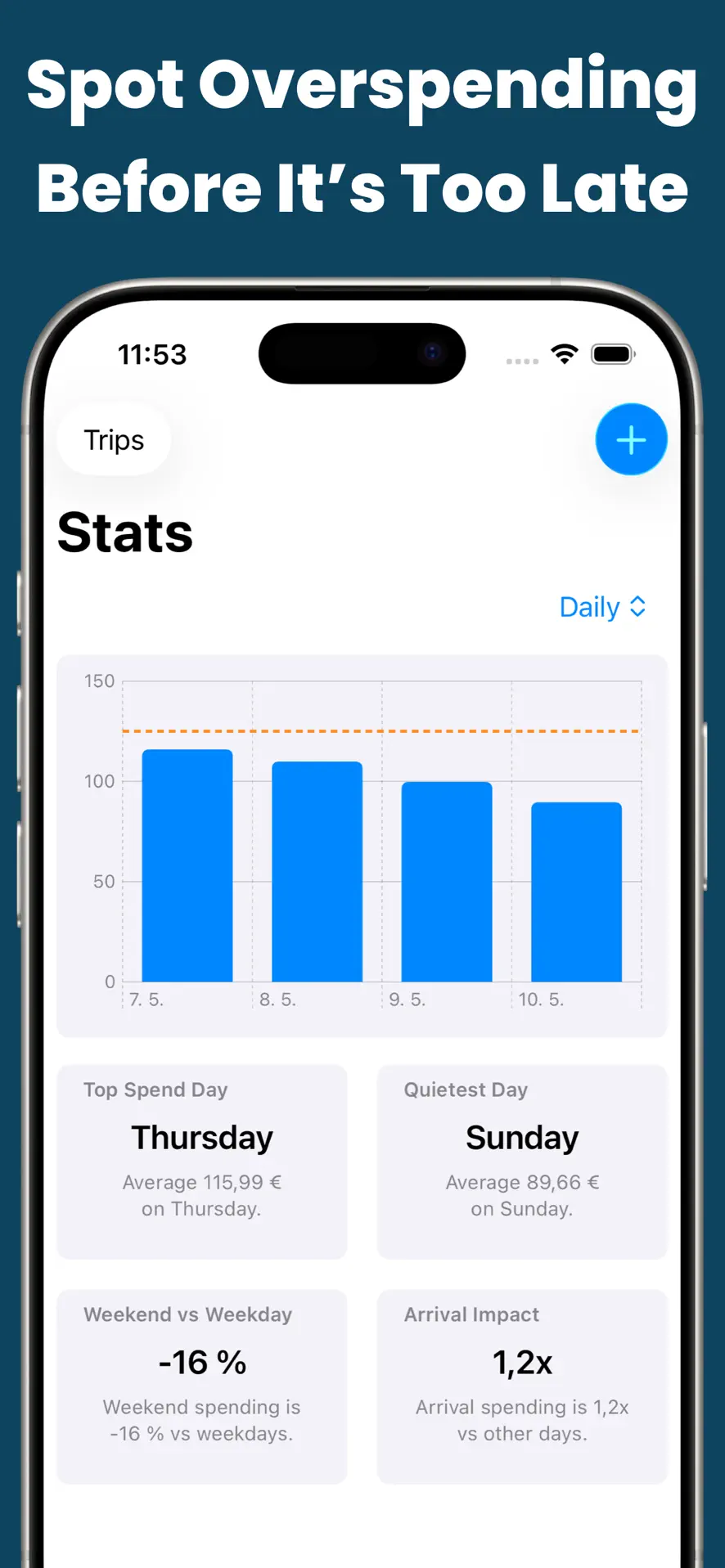
Short answer: divide your trip fund into a daily number per country rather than one global average, log everything including street food and local buses, and check the running surplus. On a long trip, cheap days are what pay for expensive ones. The metric that matters is your rolling daily average versus your target, not any single day.
The daily number is the whole game
Long trips are unforgiving of averages calculated at the end. If your target is $45 a day and you are running at $58, you are not “a bit over”. You are cutting five weeks off a six-month trip. The earlier you see the drift, the cheaper it is to correct.
Trip length × daily average = the only equation that matters
Every other budgeting decision on a long trip is downstream of it. Overspending by $13 a day for a month costs $390, roughly two weeks of accommodation in Southeast Asia.
Set a daily budget per country, not per trip
A single global daily average across wildly different countries hides the problem until it is expensive. Vietnam and Japan do not belong to the same number.
Set a target for each leg (researched from recent traveler reports, not from articles written five years ago) and then track your actual daily average against it in each country. After the first week in a new country you will know whether your target was realistic, and you can adjust the plan (more time in the cheap country, less in the expensive one) while adjusting is still possible.
Bank the cheap days
The healthiest long-trip pattern is not “spend exactly the target every day”. It is a run of quiet days (hostel kitchen, walking, laundry) that fund the days you actually came for: the dive course, the multi-day trek, the overnight train.
This only works if you can see the surplus. A tracker that shows total spend against budget alongside your daily average turns “can I afford this?” into a two-second check, which is also what stops the opposite failure: being needlessly stingy for four months and coming home with money you should have spent on the thing you traveled 9,000 km to do.
Big-ticket items
Treks, courses, safaris and internal flights distort a daily budget badly if you log them like a lunch. Two approaches, both fine as long as you pick one:
- Log it on the day it happens and accept a spike. Simple, honest, and the stats show a clear top spend day.
- Plan it as a fixed cost before the trip, take it out of the pot up front, and set your daily budget from what remains. This is the better option for anything you have already committed to.
The categories that decide long-trip budgets
Over months, three lines dominate almost every backpacking budget:
- Accommodation: usually the largest, and the one most responsive to booking a week rather than a night.
- Transport between places: moving fast is expensive; slow travel is the single biggest lever on a long-trip budget.
- Food: steady and predictable, and the one people wrongly attack first with unpleasant results.
If you are over budget, moving less usually saves more than eating worse.
Tracking a long trip in Costari
- Create a trip per country or region if you want to compare legs, or one long trip with the whole route if you prefer a single running total. Both work; consistency matters more than the choice.
- Set the daily budget for that leg. Costari shows the remaining daily budget and the surplus your cheap days have built up.
- Log everything in local currency. 150+ currencies are converted automatically, so crossing a border does not restart your arithmetic. See multi-currency expense tracking.
- Check the daily average weekly, not the single day. One expensive day means nothing; a rising seven-day average means the trip is shortening.
- Compare legs on the stats screen to plan the rest of the route around what you now know things really cost.

Costari: Travel Spend
Trip budgets, 150+ currencies, shared trips and a remaining daily budget you can check in two seconds. Free on iPhone and iPad.
Frequently asked questions
How much should I budget per day for backpacking?
It depends entirely on the region, and any single global number is misleading. Research a target per country from recent traveler reports, then correct it with your own first week of tracked data. Your real daily average is a better planning input than any published estimate.
Should I use one trip or one per country for a long journey?
One per country or base if you want to compare costs and adjust the route; one long trip if you care mainly about the overall runway. The important part is picking one and staying consistent so the daily averages remain comparable.
How do I stop a long trip from quietly going over budget?
Watch the rolling daily average rather than individual days, and check it weekly. Drift on a long trip is slow and invisible day to day, which is exactly why the average is the number to watch.