
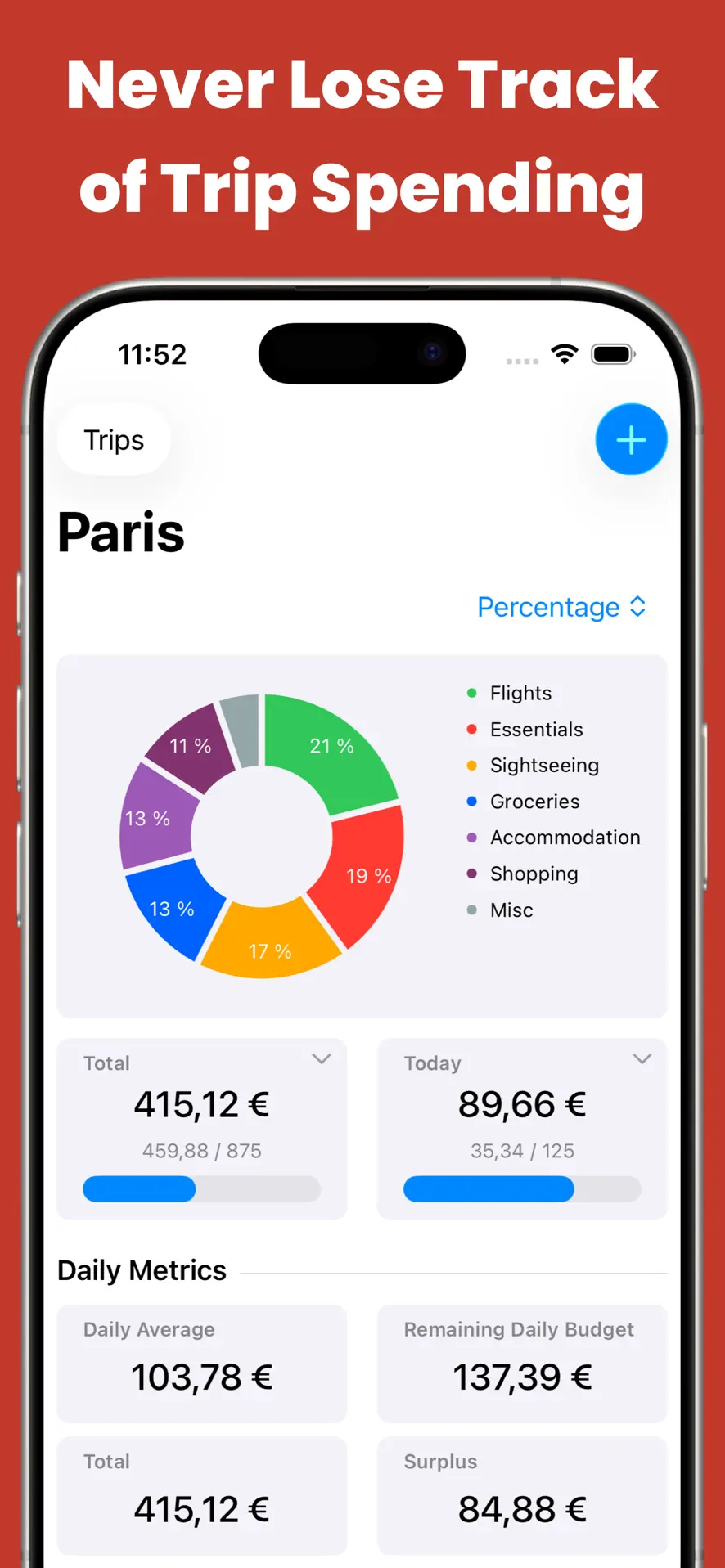
Short answer: take the money you are willing to spend on the trip, subtract everything already paid or fixed (flights, accommodation, rental car, prepaid tickets), keep 10–15% back as a buffer, and divide the rest by the number of days. That is your daily budget for food, transport, activities and everything else. On the trip, the number that matters is not the daily budget itself but what is left of it today.
The formula
Daily budget = (Trip money − fixed costs − buffer) ÷ days
Every part of that sentence does real work. Skip the fixed costs and your daily number is fantasy. Skip the buffer and day twelve is funded by your credit card.
Step 1: decide what the trip is allowed to cost
Start with the money that genuinely exists for this trip: savings you have set aside, not a number that feels reasonable. If that figure makes the trip look thin, the honest fixes are a shorter trip, a cheaper destination or a later date. Optimistic daily budgets do not survive week two.
Step 2: pull out the fixed costs
Fixed costs are anything paid before departure or unavoidable regardless of how you behave on the trip:
- Flights, trains or fuel to get there and back
- Accommodation booked in advance
- Rental car, insurance, visas, vaccinations
- Prepaid tours, festival tickets, dive courses
These belong in the total cost of the trip, but not in the daily allowance. Keeping them separate is what makes the daily number usable. See how to track travel expenses for the same distinction while you are logging.
Step 3: keep a buffer
Reserve 10–15% of the remaining money before you divide. It covers the pharmacy visit, the missed train, the taxi at 2 a.m. and the one meal you cannot resist. A trip budget with no buffer does not fail gracefully; it fails on day nine when something goes wrong.
Worked example: seven days in Paris
| Line | Amount | Note |
|---|---|---|
| Money set aside for the trip | €1,600 | What actually exists |
| Flights (paid) | −€220 | Fixed cost |
| Hotel, 6 nights (paid) | −€540 | Fixed cost |
| Museum pass (paid) | −€80 | Fixed cost |
| Buffer (12%) | −€91 | Untouched unless something goes wrong |
| Spending money | €669 | Food, transport, activities, shopping |
| Daily budget over 7 days | ≈€95/day | The number you check at dinner |
€95 a day in Paris is a comfortable-but-not-lavish day: bakery breakfast, a proper lunch, metro travel, one paid attraction and a glass of wine in the evening. If the arithmetic had produced €45, that is not a failure. It is early warning that the trip needs self-catering, and better to know that in March than on day three.
Adjust for the shape of the trip
A flat daily number is a starting point, not a straitjacket. Real trips are lumpy:
- Arrival and departure days cost more than they should: airport food, transfers, the first meal in an unfamiliar city with no idea what things cost.
- Weekends raise prices in cities and lower them in business destinations.
- Activity days (diving, tours, concerts) are worth planning as their own line rather than pretending they fit inside a normal day.
The practical version: keep one daily budget, and treat cheap days as funding for expensive ones. That only works if you can see the running surplus, which is exactly what a tracker gives you.
The number that actually changes behaviour
Not the daily budget, but the remaining daily budget. “€95 a day” is an abstraction by 7 p.m. “€37 left today” is a decision: the bistro or the takeaway. It is the one metric that turns tracking into budgeting.
How to set and track a daily budget in Costari
- Create the trip with its dates and your home currency.
- Enter a total budget or a daily budget. Costari calculates the other one, so you can plan from whichever number you actually know.
- Log expenses as you go. The trip screen updates today’s total and your remaining daily budget immediately.
- Watch the daily metrics. Daily average tells you whether your plan matches reality; surplus tells you how much cheap days have banked for the expensive one you are considering.
- Use the stats after the trip. Your real daily average is the best possible starting point for the next budget, more accurate than any “cost of travel in X” article, because it is you.

Costari: Travel Spend
Trip budgets, 150+ currencies, shared trips and a remaining daily budget you can check in two seconds. Free on iPhone and iPad.
Frequently asked questions
Should flights and hotels be part of my daily travel budget?
No. Track them as fixed trip costs so you know what the trip really cost, but keep them out of the daily allowance. A daily number is only useful if it covers decisions you make during the day: food, transport, activities and shopping.
How big should a travel budget buffer be?
Ten to fifteen percent of your spending money for a standard trip, closer to twenty for long or remote travel where a single problem (a missed connection, a medical visit, a replacement phone) can be expensive.
What if I go over my daily budget?
Nothing dramatic: it averages out, which is the point of tracking the running total. One €140 day inside a €95 budget just means the next couple of days aim lower. What matters is seeing it on day three instead of on the flight home.