
Short answer: log every expense at the moment you pay, in the currency you paid in, tagged with a category. Let an app convert it and subtract it from your daily budget, then spend two minutes each evening filling in whatever you missed. Tracking works when logging costs you ten seconds and reviewing costs you five minutes. Anything heavier gets abandoned by day four.
Why tracking expenses on a trip is different
Budgeting at home is easy mode: one currency, a handful of recurring costs, and a bank statement that explains itself. Travel breaks all three assumptions at once.
- Multiple currencies. A single week can involve euros, koruna and forint, and your bank shows all of them converted days later at a rate you did not see.
- Cash you cannot trace. One ATM withdrawal becomes fourteen untraceable purchases: coffee, a bus ticket, a market lunch, a tip.
- No routine. There is no “normal week” to compare against. A rest day costs $30 and a diving day costs $180, and both are fine.
- Shared costs. Somebody paid for the taxi, somebody else got the dinner, and nobody wrote anything down.
The consequence: reconstructing a trip afterwards from your bank app is close to impossible, and the moment you actually need the number (deciding whether to book the boat trip on day nine) has already passed.
The rule that makes tracking stick: log at the point of payment
The single behaviour that separates travelers who track successfully from travelers who give up is when they log. Not at the end of the day, not at the end of the week, but while the card machine is printing.
It sounds fussy. In practice it takes about eight seconds: open, tap plus, type the number, tap a category, done. That is shorter than checking your phone for the walking directions you are about to check anyway.
If you can only build one habit for the whole trip, build this one. Everything else in this guide is recovery for the expenses you inevitably miss.
What to log and what to skip
Log anything that leaves your account or your wallet during the trip window. That includes the airport sandwich, the tip, the €2 bathroom, and the souvenir you are pretending is for your sister.
The two judgement calls most people get wrong:
- Prepaid costs. Flights and hotels paid two months ago are trip costs, but they are not spending money. Keep them out of your daily budget or every day will look like a failure. Track them as trip fixed costs instead. See how to set a daily travel budget.
- ATM withdrawals. A withdrawal is not an expense; it is moving your own money. Log what you spend the cash on, not the withdrawal, or you will double-count. The exception is the ATM fee, which is a real expense.
Categories that actually work for travel
Home budgeting categories (groceries, utilities, subscriptions) are useless on a trip. Six to eight travel categories is the sweet spot, enough to see patterns, few enough to pick one without thinking:
- Accommodation: hotels, hostels, the extra night you added
- Food & drink: or split into groceries and eating out if you self-cater
- Transport: local buses, metro, taxis, trains between cities
- Sightseeing & activities: tickets, tours, gear rental
- Shopping: souvenirs, clothes, the charger you forgot
- Essentials: pharmacy, laundry, SIM card, fees
The value shows up at the end: “transport was 31% of the trip” is the kind of fact that changes how you plan the next one.
The five-minute evening review
Point-of-payment logging catches most things. The evening review catches the rest and takes about as long as brushing your teeth:
- Open your bank app, glance at today’s transactions, and add anything missing.
- Count the cash in your wallet. If it is less than the app expects, add the difference as a small essentials or food expense rather than leaving a hole.
- Look at the day’s total against your daily budget, and at your remaining daily budget for tomorrow.
That last step is the whole point. Tracking that never influences a decision is bookkeeping, not budgeting.
Cash, cards and the numbers that never quite match
Your tracked total and your bank statement will differ slightly, and that is normal. Card networks convert at their own rate on the day of settlement, some merchants charge in your home currency at a worse rate (always decline “pay in USD” if you are offered it), and cash rates depend on where you changed it.
Chasing a perfect reconciliation is a waste of a holiday. Being within a couple of percent is enough to make every decision the budget exists for.
How to track travel expenses in Costari
Costari is built around this exact workflow: the ten seconds at the card machine and the five minutes at night.
- Create the trip. Name, dates, home currency, and either a total budget or a daily budget. Costari derives whichever number you did not enter.
- Add an expense. Tap plus, type the amount, pick a category. If you are paying in a different currency, choose it and Costari converts it into your home currency automatically. 150+ currencies are supported.
- Check the trip screen. Total versus budget, today’s spend, daily average and remaining daily budget, all on one screen.
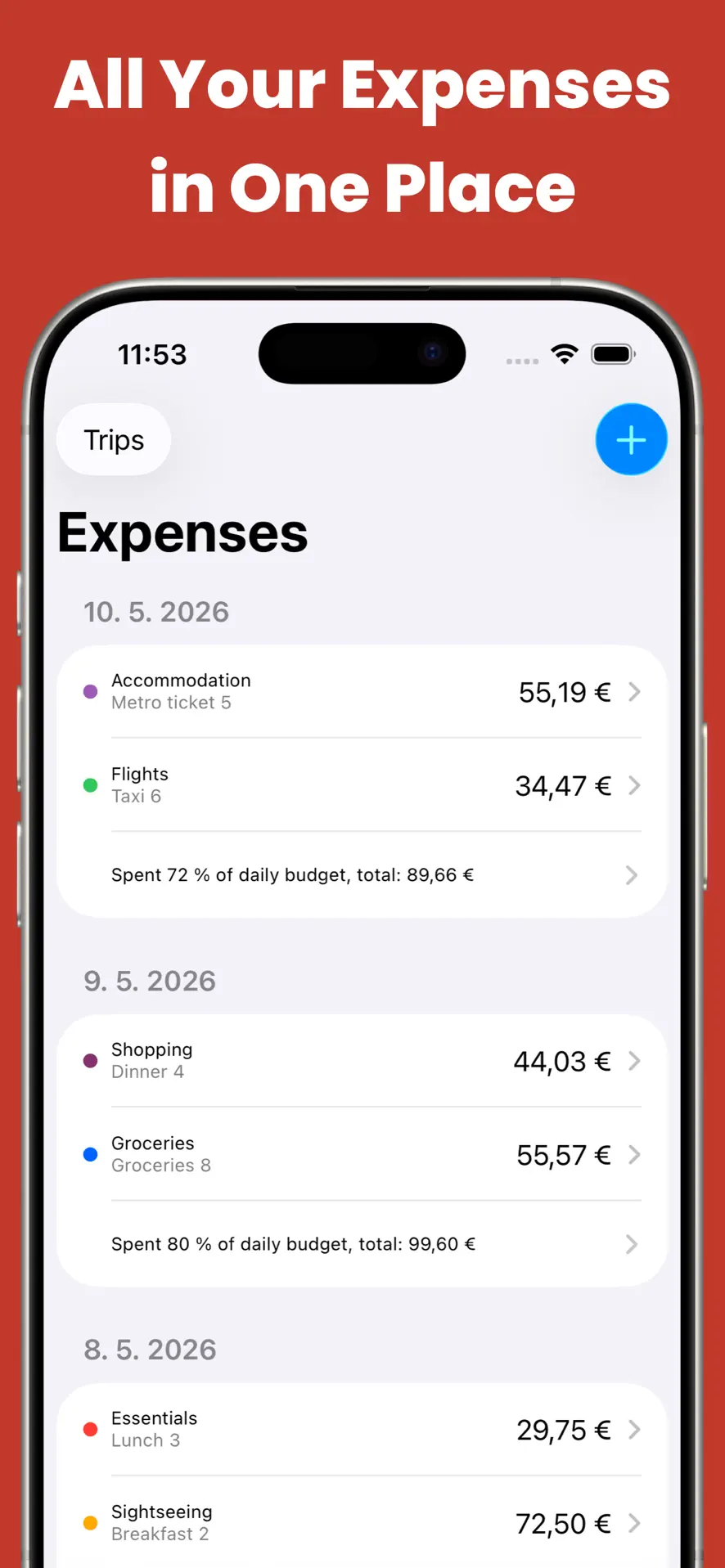
- Review the expense list. Expenses are grouped by day with each day’s total and the percentage of the daily budget it consumed, the fastest way to spot the day that ran away from you.
- Look at the stats at the end. Category breakdown, top spend day, weekend versus weekday, arrival-day impact. This is what makes your next trip budget realistic instead of hopeful.

Costari: Travel Spend
Trip budgets, 150+ currencies, shared trips and a remaining daily budget you can check in two seconds. Free on iPhone and iPad.
Frequently asked questions
How often should I log expenses while traveling?
At the moment you pay, with a short review each evening to catch anything you missed. Logging once a week means reconstructing spending from memory and a foreign bank statement, which is where most travel budgets quietly fail.
Should I track cash and card spending separately?
Track the expense, not the payment method. What matters for a trip budget is that €12 left your pocket for lunch. The one thing to avoid is logging ATM withdrawals as expenses on top of what you spend the cash on, because that double-counts every euro.
Do I need to track flights and hotels I already paid for?
Record them as trip costs so you know the true cost of the trip, but keep them out of the daily spending budget. Mixing a $600 prepaid flight into a $70 daily allowance makes the daily number meaningless.