
Short answer: record every expense in the currency you actually paid in, and let your app convert it into a single home currency for the trip totals. Never convert in your head at the till, never keep separate budgets per country, and never log ATM withdrawals as expenses. Log what you spend the cash on instead.
Log in local currency, report in one home currency
There are two ways to handle a foreign price, and only one of them survives a long trip.
The version that fails: convert in your head at the moment of payment and log the home-currency figure. It is slow, it is wrong (nobody remembers today’s rate to two decimals), and the record loses information: six months later you cannot tell whether that “$14 lunch” was 1,400 baht or 14,000 won.
The version that works: log 480 CZK as 480 CZK and let the app hold both numbers. Your expense list stays checkable against real receipts, and your trip total stays in the currency you think in.
Handling cash: the ATM double-count
The most common mistake in multi-currency tracking is logging a €200 ATM withdrawal as an expense and then also logging the meals you buy with that cash. The budget is now €200 too high and the trip looks like a disaster.
A withdrawal moves your money from one place to another; it is not spending. Two workable approaches:
- Log purchases only (recommended). Ignore the withdrawal, log the coffee, the bus and the market lunch. Add the ATM fee as a small essentials expense, because that part really is gone.
- Log the withdrawal as a lump sum if you genuinely cannot track small cash spending, common in markets and street-food countries. Accept that your category breakdown will be vague, and never mix the two methods within a trip.
Why your app and your bank will never match exactly
Three separate rates are in play on any card payment abroad:
- The mid-market rate: what apps and search engines quote.
- The card network rate: applied on the day the transaction settles, which can be two or three days later.
- Dynamic currency conversion: when a terminal offers to charge you in your home currency. Always decline. The merchant’s rate is routinely 3–7% worse than your bank’s.
Expect a small gap between your tracked total and your statement. Within one or two percent is a healthy trip budget; chasing exact reconciliation on holiday is not a good use of a holiday.
If a card machine or ATM abroad asks “pay in EUR or in your home currency?”, choose the local currency every time. That single habit usually saves more than any budgeting technique in this guide.
One trip or several for a multi-country journey?
Two sensible structures, depending on what you want to learn:
| Structure | Use when | Trade-off |
|---|---|---|
| One trip, many currencies | A continuous journey on one budget: interrailing, a three-country road trip. | Country-level comparison is harder to read. |
| One trip per country or base | You want to know what Vietnam cost versus Japan, or you are staying weeks in each place. | You have to add up the trips yourself for a grand total. |
Long-term travelers usually prefer the second. See expense tracking for digital nomads. Two-week holidays are almost always better as one trip.
Multi-currency tracking in Costari
- Set the trip’s home currency when you create it, the one you want every total in.
- Pick the payment currency on the expense. 150+ currencies are supported; choose the one you actually paid in and type the number on the receipt.
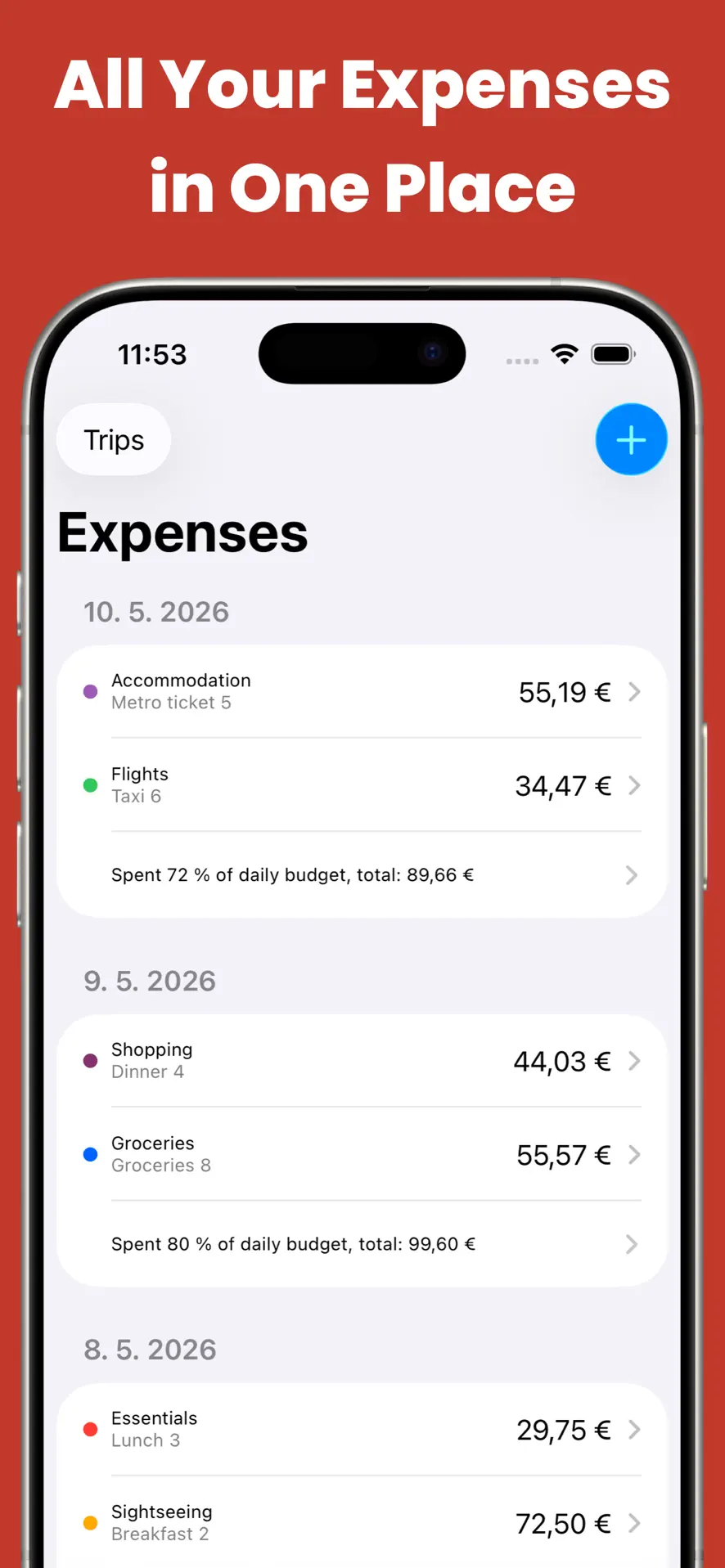
- Costari converts automatically and adds it to the trip total, today’s spend and your remaining daily budget in your home currency.
- Keep categories consistent across countries so the stats screen can compare a week in Lisbon with a week in Tbilisi.
- Log cash purchases individually, not the ATM withdrawal, and add the withdrawal fee as its own small expense.

Costari: Travel Spend
Trip budgets, 150+ currencies, shared trips and a remaining daily budget you can check in two seconds. Free on iPhone and iPad.
Frequently asked questions
Should I log expenses in local currency or my home currency?
Local currency, always. It matches the receipt, removes mental math at the till, and preserves information you cannot reconstruct later. The app converts to your home currency for the totals that matter to the budget.
How do I handle an ATM withdrawal in a travel expense tracker?
Do not log the withdrawal as an expense. Log what you spend the cash on. Otherwise every euro is counted twice. Do log the ATM fee, which is a genuine cost.
Why is my trip total slightly different from my bank statement?
Because card networks convert at their own rate on the settlement date, which is not the rate on the day you paid, and cash rates depend on where you exchanged. A gap of one or two percent is normal and does not affect any decision the budget is for.