
Short answer: add up the fixed costs first (flights, accommodation, car hire, big-ticket attractions), subtract them from what you are willing to spend, hold back 10–15% as a buffer, and turn the rest into a daily family allowance covering food, local transport, activities and souvenirs. Track that allowance while you are away so the last three days are not funded by the credit card.
Family budgets are mostly fixed costs
The proportions are different from solo travel. For a family of four, flights, accommodation and a rental car routinely account for 60–75% of the total, which is good news: most of the budget is knowable in advance and decided before you leave.
That makes the pre-trip stage the highest-leverage part. Two adults and two children on a different flight date, or an apartment with a kitchen instead of two hotel rooms, changes more than any amount of restraint on the trip itself.
Build the number in four steps
- List every fixed cost. Flights, accommodation, car and fuel or transfers, travel insurance, parking, pre-booked attractions, kennel or pet sitter, airport bag fees.
- Subtract them from the trip total you are willing to spend.
- Hold back 10–15%. With children, the buffer is not optional: a pharmacy visit, a replaced lost water bottle or a rainy-day indoor attraction shows up on most trips.
- Divide the rest by the number of days for a daily family allowance covering food, local travel, activities and souvenirs. Method detail is in how much to budget per day.
The categories that quietly break family budgets
- Eating out three times a day. The single biggest variable cost. One self-catered meal a day (usually breakfast) typically saves 15–25% of the food line without anyone feeling deprived.
- Souvenirs and gift shops. Every attraction exits through one. A fixed per-child souvenir budget for the whole trip, agreed in advance, ends the negotiation permanently and teaches something useful.
- Snacks and drinks. Small, constant and invisible unless logged. A supermarket run on arrival day beats four kiosk stops.
- Paid attractions. With children they scale badly: four tickets, four lunches, four ponchos. Mixing free days between paid ones is what keeps the budget intact.
Give the daily number to the whole family
The most effective trick in family travel budgeting is not a spending rule, it is transparency. When children (and adults) can see the day’s remaining budget on a phone screen, “no” stops being arbitrary and becomes a trade-off: the ice cream now or the aquarium tomorrow. Trips where everyone can see the number have noticeably fewer arguments about money.
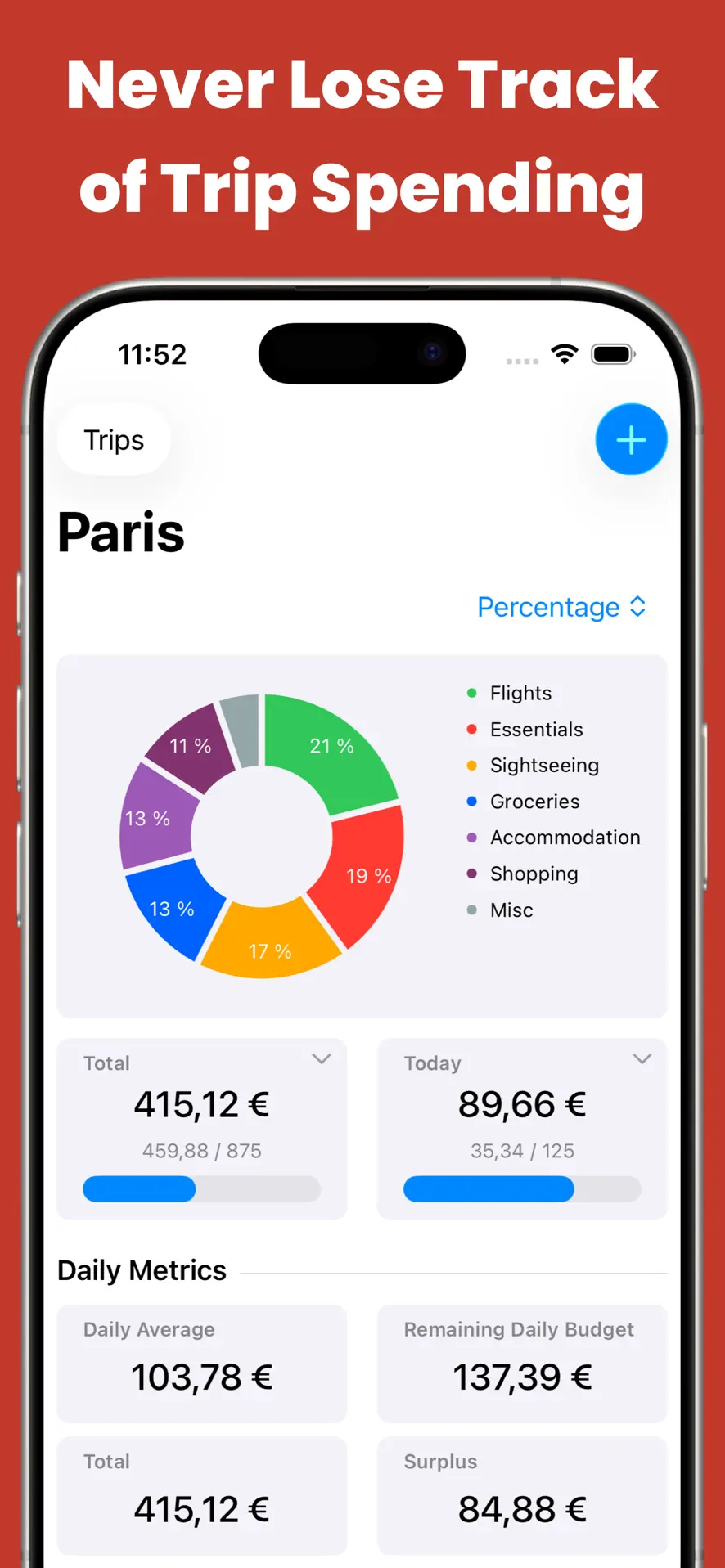
Tracking a family trip in Costari
- Create the trip with the dates and your home currency, and enter the daily family allowance you calculated (or the total; Costari derives the other).
- Invite your partner to the trip so both parents log what they pay into the same shared budget instead of comparing bank apps at the end of the week.
- Use a souvenir or shopping category so the gift-shop total is visible rather than hidden inside “other”.
- Check the remaining daily budget before deciding the afternoon. That is the moment the whole system pays for itself.
- Review the stats afterwards. The category split (especially food versus activities) is what makes next year’s family budget realistic.

Costari: Travel Spend
Trip budgets, 150+ currencies, shared trips and a remaining daily budget you can check in two seconds. Free on iPhone and iPad.
Frequently asked questions
How much should a family budget per day on vacation?
Work it out from your own numbers rather than an average: total minus fixed costs minus buffer, divided by days. For most families the daily allowance covers food, local transport, activities and souvenirs, with flights and accommodation already handled as fixed costs.
Can both parents add expenses to the same trip budget?
Yes. Invite the other traveler to the trip in Costari and both of you add expenses to the same shared budget, synced across devices, so the running total is always complete.
How do I handle kids and souvenirs on a budget?
Give each child a fixed souvenir budget for the whole trip and let them decide how to spend it. It removes the daily negotiation, protects the shopping line of the budget, and is one of the few genuinely useful money lessons a holiday can provide.